Summerfruit Facts

Australian Summerfruit Industry Facts & Profile

Australia is one of the world’s leading producers of premium summerfruit. From the Goulburn Valley to the Perth Hills, Australian growers produce peaches, nectarines, plums, and apricots across six states and more than 26 growing regions, supplying Australian households from October to April and export markets across Asia and beyond.

This page brings together the key facts, figures, and industry data for anyone wanting to understand the scale, structure, and significance of the Australian summerfruit industry.

  • ~120,000 tonnes produced annually across peaches, nectarines, plums, and apricots ⁶
  • A$375–390 million total farm gate value (2023/24) ⁴
  • A$95.28 million export value: a record for the industry (2023/24) ¹⁰
  • 39+ countries receive Australian summerfruit exports ⁶
  • 300+ SAL-registered growers across six states
  • 89 accredited export businesses across 2,723 hectares of accredited land and 58 registered packhouses ¹⁰ ¹²
  • 1 cent per kilogram levy funds industry-wide research, development, extension, and marketing ¹³

Production and export figures fluctuate seasonally. All figures cite the most recently available data. See Sources & Data for full references.

Australian summerfruit thrives in warm, dry conditions with well-drained soil, access to irrigation water, and sufficient winter cold hours (known as chilling hours) to break dormancy. The industry spans six states across more than 26 growing regions, with production concentrated in Victoria and New South Wales. ¹

The season progresses from north to south. Early fruit arrives from subtropical Queensland and the northern growing areas of Western Australia and New South Wales from October, followed by mid-season production from the Goulburn Valley, Sunraysia, and the Riverland. Cool-climate Tasmania completes the season through to April. ²
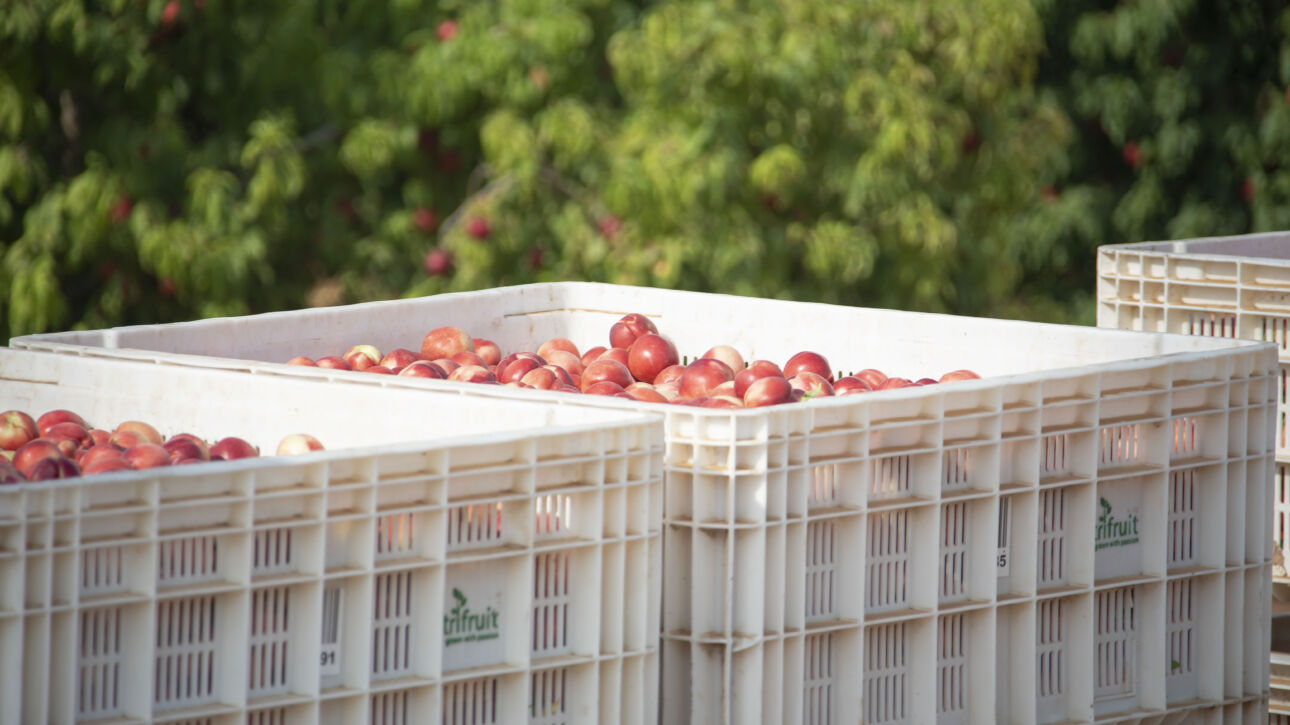
Production by State

Victoria produces approximately 70% of national summerfruit volume, with New South Wales at 10%, Western Australia 8%, South Australia 7%, Queensland 4%, and Tasmania 1%. ³

For nectarines and peaches specifically, the 2023/24 season confirms Victoria’s production at 55,455 tonnes: approximately 76% of national nectarine and peach production of 72,813 tonnes. ⁴

Key Growing Regions by State

Victoria. Australia’s largest summerfruit-producing state. Key regions include the Goulburn Valley (Shepparton, Cobram, Tatura, Ardmona), Sunraysia (Swan Hill, Mildura), and the Murray Valley. Victoria leads peach and nectarine production and is the primary growing region for apricots. ²

New South Wales. Key regions include Young, Orange, the central tablelands, and the Murray–Darling basin. Summerfruit production is strong across peaches, nectarines, and plums. ²

South Australia. The Riverland region (Renmark, Loxton, Waikerie) is the primary production zone, with particular strength in apricots. ²

Western Australia. The Perth Hills and Chittering Valley are key growing areas, particularly for early-season fruit. WA has a distinct seasonal advantage for export windows due to its earlier harvest timing. ²

Queensland. Stanthorpe in the Granite Belt is the primary production zone, with a cool-climate microclimate at altitude supporting later-season fruit. ²

Tasmania. A smaller producing region, with the cool climate producing late-season fruit of exceptional flavour. ²

Low, medium, and high chill varieties

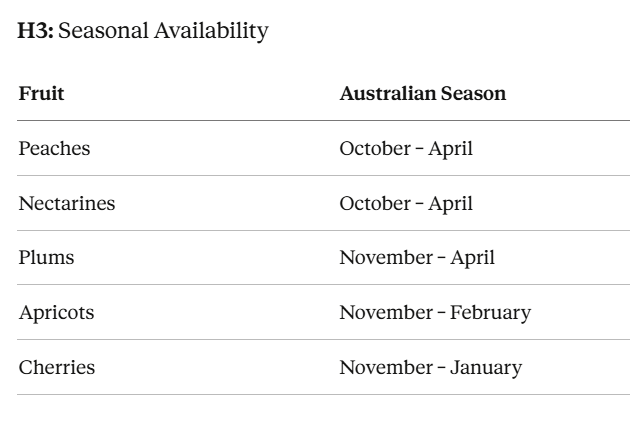
All summerfruit require a period of winter cold to break dormancy, measured as accumulated hours below 7°C. Low-chill varieties (suited to Queensland and coastal WA) produce fruit with fewer than 300 chilling hours; high-chill varieties (grown in southern NSW, Victoria, SA, and Tasmania) require 600 or more. This range of chill requirements is a key reason Australia can supply fresh summerfruit across the full six-month October–April window. ⁵

Sources:

¹ Austrade, Australian Summerfruit Industry Capability Report (2022)
² Austrade (2022); Plant Health Australia, Biosecurity Plan for the Summerfruit Industry (2019)
³ Hort Innovation, Summerfruit Strategic Investment Plan 2022–2026 (citing Horticulture Statistics Handbook 2019/20)
⁴ Hort Innovation, Summerfruit SARP (June 2025), citing Horticulture Statistics Handbook 2023/24
⁵ AgriFutures Australia (2017), cited in PHA Biosecurity Plan (2019)

Australia grows more than 380 varieties of summerfruit across peaches, nectarines, plums, and apricots. This diversity, combined with the geographic spread from subtropical Queensland to cool-climate Tasmania, is what makes a six-month fresh season possible. ⁴
Yellow and White Flesh

Both peaches and nectarines come in yellow and white flesh varieties, each with distinct flavour profiles, texture, and market appeal. Yellow flesh varieties tend to be sweet–tart with a firmer bite; white flesh varieties are lower in acid, floral in flavour, and more delicate in texture. The diversity of varieties within each category enables Australian growers to supply export markets with continuous supply across the season. ⁴

Plum Diversity

Plums are the most diverse of the summerfruit category in terms of skin colour, size, and flavour, ranging from yellow and green varieties through to deep red and near-black skinned fruit. Australian plum varieties include Black Diamond, Black Amber, Amber Jewel, Fortune, Angeleno, and the Queen Garnet, a Queensland-bred plum with exceptionally high anthocyanin content that has attracted international research interest. ⁵ ⁷

Apricots

Apricots occupy the shortest window in the summerfruit calendar, with peak season typically November through January. South Australia’s Riverland is the primary production zone. Australian apricot varieties include Moorpark, Trevatt, Goldrich, and a range of locally bred modern varieties.

Peaches and Nectarines

Peaches and nectarines together account for the majority of Australian summerfruit production and export volume. The season runs from October to April, supported by the full chill-requirement spread across states.

Sources:

⁴ Austrade, Australian Summerfruit Industry Capability Report (2022); SAL Variety Chart (summerfruit.com.au)
⁵ Netzel et al. (2012), Urinary excretion of antioxidants in healthy humans following Queen Garnet plum juice ingestion; Fanning et al. (2014), cited in Taylor & Francis: Nutritional Quality and Bioactive Constituents of Six Australian Plum Varieties (2020)

The domestic fresh market is the primary destination for Australian summerfruit. Of the approximately 120,000 tonnes produced each year, the majority is sold domestically as fresh fruit, with a portion going to processing (canning, jam, dried fruit, juice) and the remainder exported. ⁶

Australian Summerfruit in the Domestic Market

The Australian domestic fresh market is the primary destination for Australian summerfruit. In 2019/20, 65% of production went to domestic fresh, 19% to processing, and 15% to fresh export. Over time, the industry has shifted progressively away from processing toward fresh market and export: over 70% of production is now sold as fresh fruit. ³

The 2023/24 season data reflects this shift. For nectarines and peaches, 66% went to domestic fresh, 18% to export, and 16% to processing. For plums, 45% went to domestic fresh, 26% to fresh export, and 29% to processing, reflecting plums’ growing significance in export markets. ⁴

How Australians Buy Summerfruit

Summerfruit is primarily purchased through retail channels, which account for 70–80% of domestic volume. Of retail sales, 60–70% flows through major supermarkets and 30–40% through greengrocers. Around 9% of domestic fresh supply goes to foodservice. ³

67% of Australian households purchase summerfruit, with the average household making approximately 8.8 summerfruit purchases per year: around once every 2.5 weeks during the season. ⁸

Household purchase penetration spikes in late December and early January, the peak of the Australian summerfruit season. ⁹

What Drives Purchase

Taste is the primary positive driver of summerfruit purchasing decisions. Consumers who experience poor eating quality are significantly less likely to purchase again, making in-season fruit quality and eating ripeness at point of sale a commercial priority for growers, packers, and retailers alike. Early-season fruit commands a strong price premium; prices typically soften as seasonal supply increases. ³

Sources:

³ Hort Innovation, Summerfruit SIP 2022–2026 (citing Horticulture Statistics Handbook 2019/20)
⁴ Hort Innovation, Summerfruit SARP (June 2025), citing Horticulture Statistics Handbook 2023/24
⁸ SAL Summerfruit Merchandising Guide (Hort Innovation)
⁹ Hort Innovation / NIQ, 2024/25 Domestic Season Performance Report

Australia exports summerfruit to more than 39 countries, with Asian markets accounting for the large majority of export volume and value. Australia’s counter-seasonal position relative to the northern hemisphere is a key commercial advantage: fresh Australian summerfruit arrives in Asian markets during their winter, commanding a premium over competing origins. ⁶
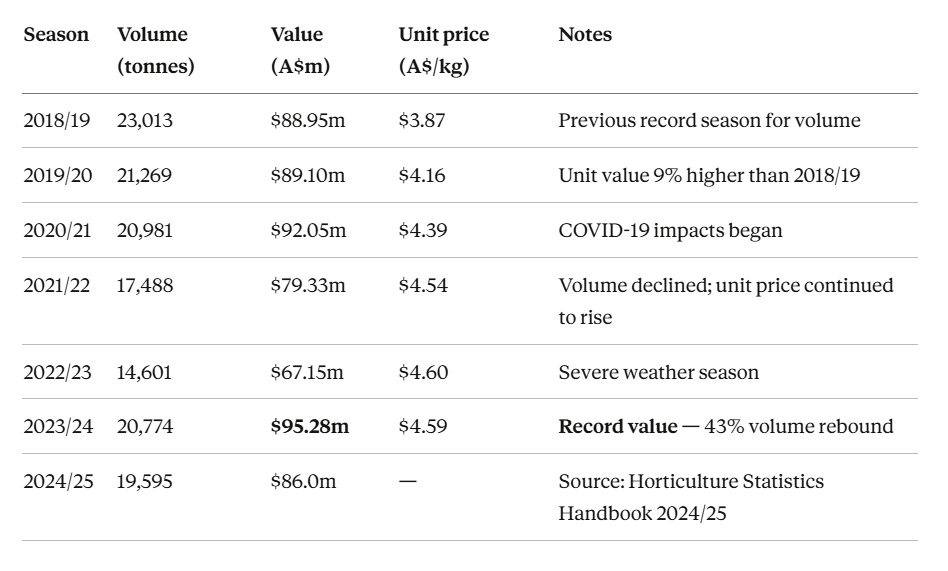
The 2023/24 season delivered a record export value of A$95.28 million: the highest in the industry’s history, despite not reaching the volume record of 2018/19. This reflects the consistent rise in unit prices from A$3.87/kg in 2018/19 to A$4.59/kg in 2023/24, demonstrating the growing premium market positioning of Australian summerfruit. ¹⁰

Victoria dominates export volumes. In 2023/24, Victoria exported 17,099 tonnes: 82.3% of the national total: up 49% on the prior season. NSW exported 3,048 tonnes (14.7% share), also up 49%. Together these two states accounted for 97% of exported summerfruit volume. ¹⁰

Variety Mix in Exports (2023/24)

By volume, nectarines accounted for 43% of summerfruit exports, peaches 22%, plums 34%, and apricots 1%. ¹⁰

Export Infrastructure

As at 2023/24, the Australian summerfruit export industry comprises 89 accredited export businesses across 2,723 hectares of accredited land and 58 registered packhouses. Protocol markets requiring farm and packhouse accreditation prior to export are China, Taiwan, Thailand, and Vietnam. ¹⁰ ¹²

Australia’s Competitive Position

Australia’s key advantages in export markets are biosecurity standards, paddock-to-plate traceability, counter-seasonal supply, and eating quality. Australian summerfruit commands a significant price premium over competing origins in Asian markets.

Chile is Australia’s primary competitor in Asian summerfruit markets. Australia currently holds approximately 10% of Southern Hemisphere summerfruit trade into Asia: a share with significant room to grow, supported by the industry’s 40,000-tonne export target by 2030. ¹⁰

Export Growth Target

The Australian summerfruit industry has set a goal of reaching 40,000 tonnes of annual exports by 2030: approximately double recent seasonal volumes. Market access and market development are the two highest priorities for achieving this target. ¹⁰
Sources:

⁶ Austrade, Australian Summerfruit Industry Capability Report (2022)
¹⁰ SF19000 Final Report, Hort Innovation (SF19000 Summerfruit Market Access & Trade Development Project)
¹¹ Hort Innovation, Australian Horticulture Statistics Handbook 2024/25 (Trade section, year ending June 2025)
¹² DAFF, Industry Advice Notice 2024-35: Applications for export of summerfruit to protocol markets (agriculture.gov.au)

The summerfruit industry makes a direct contribution to regional Australian economies. The majority of production is concentrated in inland river communities: the Goulburn Valley, Sunraysia, Riverland, and Young district: where summerfruit orchards are a cornerstone of local employment, land use, and agricultural identity.

Farm Gate Value

The Value Over Volume Story

One of the defining characteristics of the modern Australian summerfruit industry is that farm gate value has grown even as production volumes have declined from their historic peak.

Production volumes reached a high of approximately 160,000 tonnes in 2012/13, driven partly by a large processing sector. Since then, volumes have trended downward, reaching approximately 100,000 tonnes in recent seasons. This reflects difficult seasonal conditions and a deliberate industry shift away from low-value processing toward premium fresh market and export channels. ³

Despite lower volumes, farm gate value has risen substantially. Total summerfruit production value peaked at A$461 million in 2018/19, up from A$331 million in 2012/13: driven by improved variety selection, higher fresh market prices, and stronger export unit returns. ³

For 2023/24 specifically:

  • Nectarines and peaches: 72,813 tonnes at A$291.5 million
  • Plums: 27,905 tonnes at A$71.4 million
  • Combined (excluding apricots): A$362.9 million confirmed, with total industry value estimated at approximately A$375–390 million once apricots are included ⁴

Employment and Regional Communities

Summerfruit production is highly labour-intensive, particularly at harvest, generating significant seasonal employment in the Goulburn Valley, Sunraysia, Young district, and other producing regions. While precise national employment figures for summerfruit alone are not published separately from broader horticulture data, these regions rely on thousands of seasonal workers annually across picking, packing, and processing operations.

The Levy System

The summerfruit industry is funded through a statutory levy of 1 cent per kilogram of production, introduced in 1999. This levy, managed by Hort Innovation through the Summerfruit Fund, finances research, development, extension, and marketing programs. Matched Australian Government funding amplifies the levy investment. SAL administers the industry’s strategic priorities and directs how levy funds are allocated. ¹³

Sources:

³ Hort Innovation, Summerfruit SIP 2022–2026 (citing Horticulture Statistics Handbook 2019/20)
⁴ Hort Innovation, Summerfruit SARP (June 2025), citing Horticulture Statistics Handbook 2023/24
¹³ Hort Innovation / SAL, Industry Annual Report (2011), cited in PHA Biosecurity Plan (2019)

Australia’s summerfruit industry operates within one of the world’s most rigorous biosecurity frameworks. Australia is free from several major agricultural pests that affect summerfruit production in other countries, providing a significant market access and premium pricing advantage. ¹⁴

The summerfruit industry is a signatory to the Emergency Plant Pest Response Deed (EPPRD), coordinated by Plant Health Australia. The EPPRD establishes cost-sharing obligations in the event of an emergency plant pest response. ¹⁴

All farms and packhouses exporting to protocol markets (China, Taiwan, Thailand, and Vietnam) must be accredited by the Department of Agriculture, Fisheries and Forestry (DAFF) and comply with phytosanitary requirements. These include pest-free area certification and, in some markets, cold treatment or irradiation prior to export. ¹²

Sources:

¹⁴ Plant Health Australia, Biosecurity Plan for the Summerfruit Industry (2019)
¹² DAFF, Industry Advice Notice 2024-35 (agriculture.gov.au)

Summerfruit Australia is the authoritative source for industry data and commentary on the Australian summerfruit sector. For media enquiries, interview requests, or data requests beyond what is published on this page, please contact us directly.

Get in touch →

For the most current season-by-season production and export statistics, the following are the primary data sources:

  • Hort Innovation Horticulture Statistics Handbook — published annually; the definitive source for Australian horticulture production and export data by commodity. Available at horticulture.com.au.
  • ABARES Agricultural Commodity Statistics — published by the Australian Bureau of Agricultural and Resource Economics and Sciences; includes broader agricultural context. Available at agriculture.gov.au/abares.
  • Australian Bureau of Statistics (ABS), Australian Agriculture: Horticulture — available at abs.gov.au.
  • USDA Foreign Agricultural Service Stone Fruit Annual (Australia) — published annually, provides US government analysis of Australian stone fruit production and export outlook. Available at fas.usda.gov.